

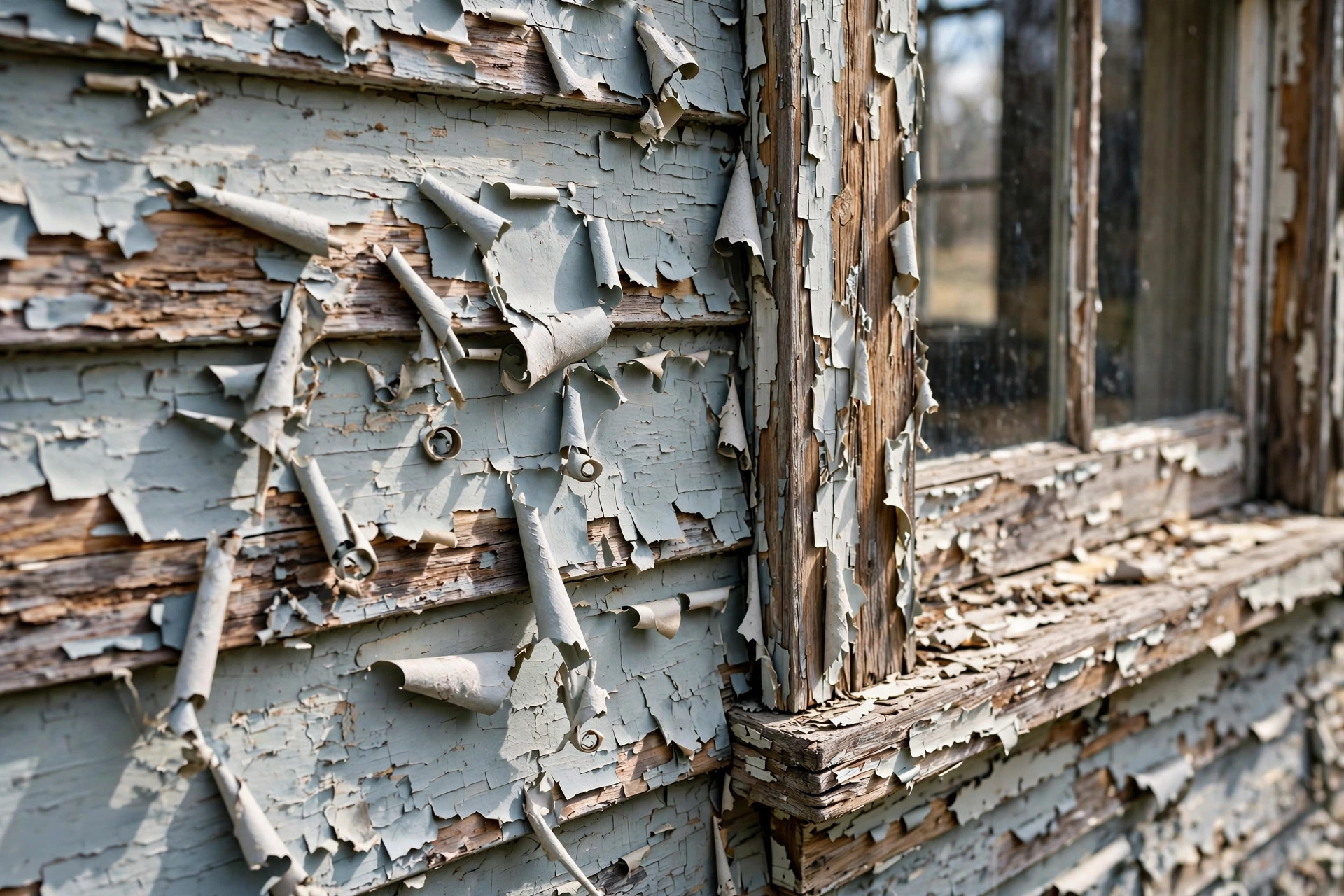
It’s early October in Vancouver. We’ve got a few dry weeks left before the winter rains move in for good, and every fall, the same thing happens: homeowners call us about something they noticed on their siding back in July and figured could wait.
Here’s the straight version: exterior paint rarely fails overnight. It warns you first. We walk a lot of houses in September and October, and the pattern is always the same. Catch these signs now and you’re looking at a standard repaint. Let them ride through one more wet winter and you’re paying for repairs plus the paint job. These are the seven things we tell our own clients to watch for.
1. Peeling or flaking paint
This is the big one. Peeling means moisture has gotten behind the paint film, through failed caulking, worn flashing, or just years of rain working into tiny cracks. In this climate, once water gets behind paint, it doesn’t dry out and go away. It keeps lifting.
Why waiting costs you: a peeling patch doesn’t stay a patch. Every rainstorm widens it, and the exposed wood or siding underneath takes a beating all winter. What would have been a wash and a scuff-sand becomes scraping, sanding, and priming, and that’s billed by the hour.
2. Fading or chalking
Run your hand across the siding. If it comes away with a chalky residue, the sun has broken down the paint’s binder. That’s called chalking. South- and west-facing walls go first; they take the worst of the UV.
Why waiting costs you: chalk has to come off completely before new paint will bond, which means a serious wash or hand-scrub of the whole wall. And faded paint is thin paint. It’s already doing less protecting than you think.
3. Soft or rotted wood on trim, fascia, or sills
Press a screwdriver into your window trim, fascia boards, and sill noses. If it sinks in, that’s rot, and it’s the most common repair we do on Vancouver exteriors. Water sits on horizontal trim, finds a crack, and the wood goes soft from the inside out.
Why waiting costs you: rot spreads. A trim board you could have replaced cheaply this fall becomes reframing and re-flashing by spring. And no paint sticks to rotted wood. It all has to be cut out first.
4. Cracked or missing caulking around windows and doors
Caulk shrinks, hardens, and cracks with age. Walk around and look at the joints where trim meets siding and where windows meet their frames. Gaps there are a direct path for rain into your wall assembly.
Why waiting costs you: water getting in behind the trim shows up as peeling paint nearby, and sometimes as damage to the sheathing you can’t see. Re-caulking is one of the cheapest line items on a repaint. Repairing what’s behind failed caulk is not.
5. Mildew or moss on shaded walls
North-facing walls and anything under big trees grow a green or black film in our climate. It’s easy to dismiss as cosmetic, but mildew holds moisture against the paint around the clock.
Why waiting costs you: it etches into weakening paint, so the cleaning gets more aggressive each year, and it colonizes failing paint faster than sound paint. A wall that’s staying damp is a wall whose paint is on borrowed time.
6. Hairline cracks in stucco
Stucco moves with temperature and settling, so hairline cracks are normal, but they’re still openings. Rain gets in, and even Vancouver’s mild freeze-thaw cycles work those cracks wider over winter.
Why waiting costs you: small cracks become bigger cracks, and water behind stucco makes it delaminate in patches. Then it’s a stucco patch repair on top of the paint job instead of just crack-filling during prep.
7. Bubbling or blistering paint
Blisters are moisture vapor pushing the paint film off the surface from behind. You’ll see them most on sun-hit walls after rain. The heat turns trapped moisture to vapor and it has nowhere to go.
Why waiting costs you: blisters pop and leave bare spots that peel in sheets. There’s no shortcut here: every blistered area has to be scraped back to sound paint, sanded, and primed. The longer it goes, the more wall ends up in that category.
The real cost of waiting a year
Here’s the math nobody tells you: most of an exterior paint job’s price is prep, not paint. Sound paint gets washed, masked, and coated twice. Failing paint gets scraped, sanded, patched, caulked, and spot-primed before a single finish coat goes on, and that labour adds up fast.
Every wet winter moves more of your house from the first category into the second. That’s not a sales pitch, it’s just how the work breaks down. One thing people get wrong: they assume a repaint means stripping the whole house. It doesn’t. We only take back what’s failing. But the more that’s failing, the more hours, and hours are what you’re paying for. If you’re wondering what the numbers look like, our Vancouver painting cost guide lays it out honestly.
What a proper exterior repaint actually includes
A repaint that lasts in this climate isn’t just colour. It’s a full pressure wash, scraping and sanding every failure back to sound paint, replacing rotted trim, re-caulking every joint, spot-priming bare areas, then two full coats of quality exterior paint. We spray and back-roll. The roller works the paint into the surface so it bonds instead of just sitting on top. We use Sherwin-Williams SuperPaint, which carries a manufacturer’s lifetime warranty. The film has to be built right to earn that.
You can see the standard we hold on our exterior painting page and in recent projects around Metro Vancouver.
A note on timing: the October window
Exterior paint needs dry surfaces and decent temperatures while it goes on and cures. Right now, in early October, we’re in the last reliable stretch of both. Once the rains set in, exterior work gets pushed to spring, and everything above keeps deteriorating all winter.
If your place is showing two or three of these signs, this is the window. And if the exterior has to wait until spring, remember interior painting is a year-round job. Plenty of our clients do the inside over winter and book the exterior for the first dry spell.
FAQ
How often should a house be repainted in Vancouver?
With quality prep and paint, typically every 7 to 10 years in our climate, with south and west exposures sooner. But there’s no calendar rule that beats the signs above. We’ve repainted five-year-old jobs done badly and fifteen-year-old jobs done right.
Can you paint exteriors in fall or winter here?
We paint exteriors while surfaces stay dry and temperatures hold during application and cure, which is exactly why October matters. Once it’s consistently wet and cold, we stop booking exteriors until spring.
Is it cheaper to just paint over peeling paint?
It looks cheaper for about a season. New paint over failing paint peels with the old layer underneath, usually faster, because the new film adds weight to a bond that’s already letting go. The prep is the job; skipping it is how you pay twice.
Will you come out and look at my house?
Yes. Call us and we’ll set up a walkthrough. We’ll go around the place with you, point out what’s urgent and what can honestly wait another year, and put together a clear, itemized proposal. No pressure either way.
Seeing any of these on your place?
The smart move is a walkthrough before the rains. We’ll tell you straight what’s urgent and what can wait. Call Exceptional Painting at (236) 995-6777. We’re rated 4.8 stars from 232 Google reviews, carry $5M in liability insurance, run WCB-covered crews, and every exterior leaves with premium paint backed by a manufacturer’s lifetime warranty. Or get in touch here and we’ll set up a time.